
- News
- City News
- delhi News
- For keen eyes: Crafted with care, fine arts centre plays to gallery
Trending
This story is from October 17, 2022
For keen eyes: Crafted with care, fine arts centre plays to gallery
It might resemble a wedge of a cake with its top bitten off, but the All India Fine Arts and Crafts Society near Parliament House actually represents a slice of history.
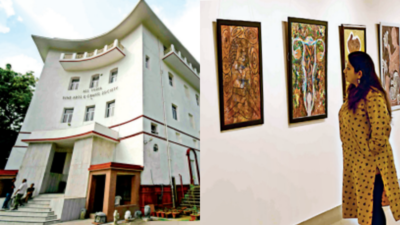
All India Fine Arts and Crafts Society
For seven decades, the three-storied, white building with jali-enclosed floating balconies has benignly kept an eye on the city’s art and culture from its location at the junction of Rafi Marg and Red Cross Road.

After getting its own building in 1952, inaugurated by President Rajendra Prasad, AIFACS (pronounced a-fax) played an important part in the promotion of the arts and culture of the country through the decades. From its inception till 1954, when the Lalit Kala Akademi was established, AIFACS was often the vehicle of interaction on art and culture between India and the world.
Indeed, in 1928, when the colonial rulers built India House in London, AIFACS organised its first All India Art Exhibition in the British capital to enable the government to select the artists whose work would adorn the new agency for the Indian government in that city. Four participating artists — Dhirendra Krishan Deb Burman, Ranada Ukil, Lalit Mohan Sen and Sudhangshu Choudhury — were pinpointed for the job and their works still adorn India House in London, where it currently houses the Indian high commission.
Thus began the AIFACS tradition of art exhibitions and promotion of art and craft from across India. The headquarters has four galleries, two on the ground floor and two on the lower ground floor. The triangular building’s second floor has the office of AIFACS.
The exhibition sent to London in 1928 received such a good response that it travelled from there to other European countries for four years. Since then, the historic building has hosted 93 annual all-India art exhibitions. It has also held 11 international contemporary art exhibitions, giving the people of Delhi the opportunity to keep abreast of trends in global art.
Besides painting, photography and pottery, other and newer forms of art have also been embraced as being integral to the rich culture of the country. It has presided over the evolution of art forms while preserving the fading expressions of beauty and culture. For instance, to encourage the slowly dying watercolour style, it has organised several exhibitions in the painting method.
Shabbir Ahmed, an art enthusiast, said the building itself represented art with its unique architecture, standing out even among the surrounding edifices like Parliament House and ministerial buildings. And though art and architecture enthusiasts are intrigued by the unusual shape of the building, the reason is quite plebeian: the plot on which it was built had a triangular shape.
“It wouldn’t be incorrect to say that this building has been the scene of an art revolution,” said Ahmed, who was arranging the galleries for an upcoming exhibition. “Be it photography, watercolour, oil or pastel art, pottery or paper cut art, AIFACS has been a witness to the changes in Indian and global art.”
The 70-year-old building is under renovation. Mukesh Kumar Tank, manager (exhibitions), said that renovation work is taken up only when necessary, deeming the internal structure of the building strong enough to sustain the harsh climate of the capital.
Fridays are the busiest at the galleries as art students and volunteers work on the upcoming exhibitions, which usually last a week. Sonali Gupta, an art student, was busy decorating the entrance with flowers. She said such work filled her with pride. “I have volunteered for art exhibitions in private galleries too, but AIFACS holds a special place in my heart,” Gupta beamed. “I hope someday my artworks will make it to the galleries here.”
Tank said the galleries are always booked for exhibitions and the staff can hardly stop to take a breath. “The pandemic changed the scenario, but things are picking up again and we have started hosting exhibitions almost every week now,” said Tank.
The advent of private galleries hasn’t affected the shows at AIFACS, claimed Tank. “The private galleries are doing business. We are not into the art business. From promoting first time artists to veteran artists, we are here to promote art,” he added.
Besides the regular cultural ties between India and other nations through art that AIFACS promotes by showcasing art from different continents, the triangular building also has many firsts to its name, including the first All India Art Exhibition of 1928, and then the first International Graphic Art Exhibition in 1974, the first All India Photo Exhibition in 1972 and the first All India Traditional Art Exhibition the same decade.
“We expect many more firsts in the future,” said Tank, reverence in his tone, in awe perhaps at the society and its iconic headquarters’ sustained journey through the eras.
End of Article
FOLLOW US ON SOCIAL MEDIA
Photostories

Hot Picks
TOP TRENDING
Popular Categories
Hot on the Web
Top Trends
Hurricane MiltonRatan Tata NewsNew UPI Transaction LimitRatan Tata DiesPM ModiShantanu NaiduTom BradyStock Market TodayNarayana MurthyHarry BrookIsrael Hezbollah WarRahat Tata Inspiring QuotesManagement Colleges of IndiaTop Medical Colleges of IndiaTop Engineering Colleges of IndiaTop Pharmacy Colleges of IndiaLive Cricket Score
Trending Topics
Diwali WishesBigg Boss Tamil 8 Contestants ListBhool Bhulaiyaa 3 TrailerVettaiyan Twitter ReviewSanjay Leela BhansaliVettaiyan ReviewSalman KhanDevara CollectionBigg Boss 18Deepika PadukoneShraddha KapoorRatan Tata Passed AwayColdplayVettaiyan Movie ReviewSwatantrya Veer SavarkarDussehra 2024Watch NFL Live StreamDress To ImpressRatan Tata DeathWordle Answer
Living and entertainment
Latest News
How Chennai Night Race swerved past challenges to zoom toward a brighter motorsports futureAll-Star Tower Defense (ASTD) Codes October 2024Ranveer Singh: I have a man crush on Tiger ShroffWho is Noel Tata? Meet Ratan Tata’s half-brother, who could be successor at Tata TrustsHow to make Ginger Turmeric Shots for seasonal changeWhen Amitabh Bachchan slept on Marine Drive with rats as neighbours: I didn’t have a place to stay'You're drunk': Britons stunned by BBC app's shocking 18,995 mph wind forecast!Hanging Lights For Living Room: Transform and Illuminate Your SpaceICC Women's T20 World Cup: Harmanpreet Kaur, Smriti Mandhana, bowlers demolish Sri Lanka as India get NRR boostOnly a true creative genius can spot the odd unicorn in 12 seconds!Ratan Tata no more: When his throwback pic had netizens saying he looked like a Hollywood star'Vettaiyan' Twitter review: Rajinikanth shines in this investigative thriller'Vettaiyan' early and first review: Rajinikanth starrer has a good twist!CATS YouTube codes for October 10, 2024: Enhance your gameplay and know how to redeem the codesKarnataka BJP chief hints at CM Siddaramaiah’s possible exit amid 'fast-paced political changes'Bigg Boss 18: Karan Veer Mehra opens up about losing his father at the age of 10; says 'Main apne dad ki death par nahi roya'Exploring the link between spirituality and mental health on World Mental Health DayAAP alliance could've helped Congress in Haryana, but just to boost its tally by 3
Copyright © 2024 Bennett, Coleman & Co. Ltd. All rights reserved. For reprint rights: Times Syndication Service